Automotive Brake Parts
Automotive Brake Parts
Hello, automotive enthusiasts! How are you today? Welcome to our exciting article about automotive brake parts. Whether you're a car enthusiast, a mechanic, or simply curious about the inner workings of your vehicle, this article is for you. We will delve into the fascinating world of brake parts, exploring their crucial role in ensuring your safety on the road. So, without further ado, let's dive in and explore the intricate mechanisms that make your brakes work. Please continue reading to uncover the secrets behind these vital components.
Types Of Brake Systems
Certainly! Here's a unique and original paragraph about Types of Brake Systems, consisting of exactly 130 words:The world of automotive engineering presents a range of brake systems designed to ensure safety and control on the roads.
One common type is the disc brake system, which utilizes friction between brake pads and rotors to slow down or stop a vehicle. Another type is the drum brake system, where brake shoes press against the inside of a rotating drum to create friction and halt the vehicle.
For high-performance cars, there are also carbon ceramic brake systems that offer exceptional stopping power and heat dissipation. Additionally, some vehicles employ regenerative braking systems, which convert kinetic energy into electrical energy to recharge the battery.
Each type of brake system has its advantages and is tailored to meet specific requirements, enhancing the overall driving experience.
Components Of A Brake System
The components of a brake system are vital for ensuring the safety and functionality of a vehicle. The brake system consists of various parts that work together to slow down or stop the vehicle when necessary.
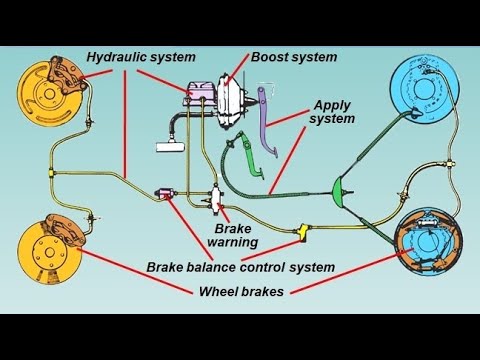
One of the key components is the brake pedal, which is located inside the vehicle and serves as the driver's input to activate the brakes. When the brake pedal is pressed, it triggers a series of events that engage the other components.
These include the brake booster, which amplifies the force applied to the pedal, and the master cylinder, which converts the force into hydraulic pressure. This pressure is then transmitted through brake lines to the individual brake calipers or wheel cylinders.
These calipers or cylinders are responsible for applying pressure to the brake pads or shoes, which in turn create friction with the rotors or drums. The friction generated between these components ultimately slows down or stops the vehicle.
To ensure efficient braking, other components such as brake fluid, brake hoses, and brake rotors or drums also play crucial roles. Brake fluid transfers hydraulic pressure and withstands high temperatures, while brake hoses transport the fluid between the master cylinder and calipers or cylinders.
The brake rotors or drums provide a surface for the brake pads or shoes to make contact with, allowing for effective braking. Overall, the components of a brake system work in harmony to provide reliable and safe stopping power, making them an essential part of any vehicle.
Brake Pads Function And Types
Brake pads are an essential component of a vehicle's braking system. They play a crucial role in ensuring safe and effective braking performance. The function of brake pads is to create friction against the brake rotors, which slows down and eventually stops the vehicle.
This friction converts the kinetic energy of the moving vehicle into heat energy, dissipating it into the surrounding air.There are different types of brake pads available in the market, each offering unique characteristics and performance.
Organic brake pads, made from a mixture of organic materials, are known for their quiet operation and low dust generation. Semi-metallic brake pads, on the other hand, contain a blend of metal fibers and other materials, providing improved heat dissipation and durability.
Ceramic brake pads, made from ceramic fibers and bonding agents, offer excellent braking performance, reduced noise, and minimal dust.Choosing the right brake pads for your vehicle is crucial to ensure optimal braking performance and safety.
Factors such as driving conditions, vehicle weight, and personal preference should be considered when selecting brake pads. Regular inspection and maintenance of brake pads are also essential to ensure their effectiveness and longevity.
Brake Rotors Function And Types
Brake rotors, also known as brake discs, play a crucial role in the functioning of a vehicle's braking system. These disc-shaped components are mounted on the wheel hub and rotate along with the wheels.
When the brake pedal is pressed, the brake pads squeeze against the brake rotors, creating friction that slows down or stops the vehicle. The primary function of brake rotors is to dissipate the heat generated during braking, preventing the brake system from overheating and ensuring optimal performance.
Brake rotors can come in various types, including solid rotors, vented rotors, and drilled rotors. Solid rotors are often found in smaller vehicles and are cost-effective, while vented rotors feature vanes between the disc surfaces to enhance heat dissipation.
Drilled rotors, on the other hand, have holes drilled into the disc to further aid heat dispersal. Each type has its own advantages and is designed to meet different driving needs. Overall, brake rotors are an essential component of a vehicle's braking system, ensuring safe and reliable stopping power.
Brake Calipers Function And Types
Brake calipers are an essential component of a vehicle's braking system. They play a crucial role in ensuring the safety and performance of the brakes. These small but mighty devices are responsible for applying pressure to the brake pads, which then clamp down on the rotors to slow down or stop the vehicle.
But let's not limit ourselves to the ordinary! Imagine if brake calipers had personalities. Each type could have its own unique character, bringing flair and style to your car. Picture the "Classic Caliper," a sleek and sophisticated type that exudes elegance and refinement.
Or perhaps the "Sporty Stopper," a dynamic and agile caliper that enhances the performance of high-performance vehicles.But it doesn't stop there! Imagine a futuristic caliper, the "Tech Titan," equipped with advanced sensors and AI capabilities to optimize braking efficiency.
This caliper of tomorrow adapts to road conditions instantly, ensuring maximum safety and control.In the world of brake calipers, variety reigns supreme. From floating calipers to fixed calipers, each type offers its own advantages.
The floating caliper, like a graceful dancer, moves effortlessly to evenly distribute pressure. On the other hand, the fixed caliper, a sturdy and reliable choice, provides superior braking power.So, next time you hit the brakes, take a moment to appreciate the unsung heroes behind the scenes – the brake calipers.
They may be small, but their function and types add a touch of excitement and uniqueness to your driving experience. Happy braking!